


SARS-CoV-2 is a viral strain of the coronavirus species, belonging to the genus Betacoronavirus (family Coronaviridae).
Viruses: what are they?
A virus is an organism with a non-cellular organization characterized by a protein envelope or capsid that contains only one type of nucleic acid, DNA or RNA, and which duplicates itself only in the cells it infects, being an obligate endocellular parasite.
Furthermore, its proliferation occurs through the assembly of the main constituents in the host.
In particular, viruses are species-specific and can exist as extracellular entities, as virions complete with capsid and nucleic acid and in this form they are inert, they persist in the environment but do not multiply, and as intracellular entities, as a form where the virus replicates.
Coronavirus: general characteristics
Specifically, Coronaviruses are single-stranded RNA + viruses, the capsid of which has both a lipid component and a protein component.
The RNA genome is coated by the N protein, which forms a filamentous capsid in turn coated by a lipid membrane with surface viral proteins, such as spike glycoprotein (S) and dimeric hemagglutinin esterase (HE).
In particular, the spike allows the entry of viral particles into infected cells.
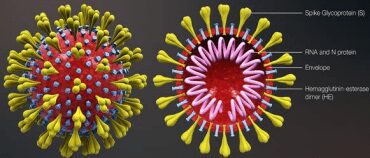
Furthermore, the lipid part in red in the figure makes us understand why a good rule of thumb to combat the spread of this virus is the use of detergents.
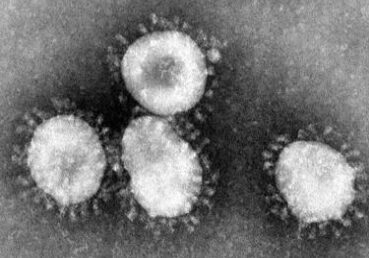
Coronavirus strains: Sars-CoV-2
Currently, we recognize 7 strains capable of infecting humans:
- 4 classic strains of the cold, isolated for many years;
- the strain isolated in 2002 responsible for the SARS epidemic, responsible for an acute respiratory syndrome at the time quite contained;
- the one isolated in 2012 responsible for the MERS epidemic, very limited;
- responsible for the current epidemic of 2020, isolated for the first time in 2019 in the city of Wuhan, China.
SARS-CoV-2, also known as Wuhan Coronavirus, is responsible for disease called COVID-19, acronym of “Coronavirus Disease 19“. This strain has been identified as a new viral strain as it has a genetic similarity of approximately 70% to the 2002 SARSCoV.
In general, one viral strain is distinguished from another when they have a grade genetic difference greater than 5-10%.
Specifically, two strains have 90% genetic identity between them so we are talking about the same viral strain.
More properly, an absolute rule of strain definition could be either at the level of genetic identity or at the level of host specificity.
Therefore, two viruses, even very similar genetically, which have different specificity of host will belong to two different strains.
Due to their genetic characteristics, Coronaviruses can be grouped into different genera and the three most dangerous strains belong to the β-Coronavirus genus.
Bat: natural reservoir of Coronavirus
These three strains all come from a natural reservoir of Coronavirus, namely from bats.
These flying mammals therefore represent the primary host of these viruses, which have had at least one intermediate host before infecting the final host (man) and thus acquire the ability to be transmitted from man to man.
In particular, the existing bat species are diverse and are estimated to cover around 20% of all mammalian species, which is why they make an excellent reservoir.
Not surprisingly, the two previous cases of epidemics already originated from a bat that transmitted the virus, as primary host, to the so-called transit species or intermediate host, an owl and a camel respectively in SARS-CoV and in MERS-CoV. Subsequently, these intermediate hosts transmitted the Coronaviruses, responsible for these epidemics in humans.
As for SARS-CoV-2, it is certain that the primary host is bats, but which is the intermediate host has not yet been fully understood. In this regard, it has been speculated that this is the pangolin.
In search of the intermediate guest
To understand which species are involved in the transmission of a given viral strain, so-called BLASTs are performed, that is, with particular software, the gene sequences (Software BLAST-N or Nucleotide) and protein (Software BLAST-P or Protein) are compared.
Belonging to different species and, putting them in alignment, a phylogenetic tree is created, so that according to the degree of similarity of the sequences it is possible to ascertain which are the closest pairs of species.
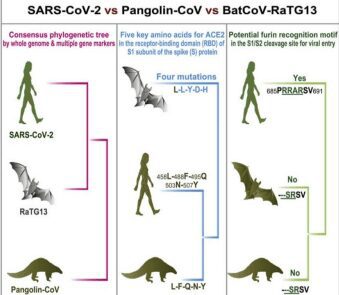
The genome of Sars-Cov-2
The SARS-CoV-2 genome is very simple and consists of approximately 30,000 nucleotides.
This genome has, at the 5 ‘end, a long sequence that codes for the polyprotein ORF1ab, followed by the sequences that code for the four main structural proteins of the envelope, the matrix, the nucleocapsid, the membrane and the surface spike glycoprotein, which serves to contact the host cell of the respiratory mucosa.
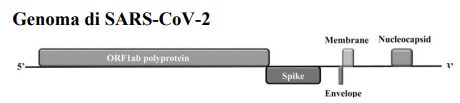
DNA polymerase, which has an error correction activity, does not intervene in genome replication, but RNA dependent RNA polymerase.
For this reason, errors are more frequent, they accumulate and determine the high ability of the virus to mutate.
Sars-Cov-2 created in the laboratory?
Recently, the spread of an old television service by TGR Leonardo in which the data of a Chinese research group was reported has caused a lot of uproar about a study published in Nature in November 2015.
The object of this research was to verify how coronaviruses in bats could potentially cause the onset of SARS-like diseases in the human population.
The purpose of the research
In this study, natural evolution was accelerated by carrying out an in vitro evolution, by inserting the spike protein gene specific for the human cell into the genome of a bat Coronavirus. In this way, this virus could infect humans directly from the bat.
However, the purpose of this research was precisely to try to understand what might be the best therapeutic strategies for a possible emergency caused by these viruses.
Therefore, the study had positive and interesting premises, as in 2015 two epidemics caused by Coronavirus, SARS and MERS, had already occurred, and therefore a future emergency scenario was expected from another Coronavirus.
These studies were initiated after the approval of the North Carolina University Biosafety Committee, which approved the experimental protocol entitled “infections generated by SARS-like CoV clones of bats”.
The spread of this old television service, as was to be expected, triggered the advance of doubts and conspiracy theories, according to which the control of this chimera virus would be lost and the current pandemic would be the effect of that study started in 2015.
The reality of the facts
In reality, when a chimera organism is created, it is as if a molecular signature is left within the genome of that virus, that is a sequence of a certain size created ad hoc and inserted in such a way as to remain in a precise position in the genome chimeric.
For example, today human insulin is produced in E. coli because the human insulin gene has been inserted into the genome of this bacterium. In order to carry out this insertion, there must be particular sequences of plasmids, necessary for the insertion of a piece of human DNA into the E. coli genome.
Similarly, to insert the spike gene, for example, of the pangolin CoV into the bat one, it is necessary to use specific sequences that can favor this recombination.
Therefore, in the sequencing of the genome of a possible chimera organism, one should observe, for example, duplications of RNA that do not exist in nature.
Well, after having isolated over and over again, in various countries, the genome of the current Coronavirus and knowing the genome of the chimeric CoV, it was found that it is not present no molecular signature in the SARS-CoV-2 genome that could indicate its possible human manipulation.
Original article “ Sars-Cov-2 è stato creato in laboratorio?”
Written and translated by Giovanna Spinosa
Sources
- https://onlinelibrary.wiley.com/doi/full/10.1002/jmv.25766;
- https://www.nature.com/articles/nm1024;
- https://www.nejm.org/doi/full/10.1056/nejme2001126.
Images’ credits
- Figura 1: https://www.efsa.europa.eu/en/news/coronavirus-no-evidence-food-source-or-transmission-route;
- Figura 2: https://www.scienzainrete.it/articolo/coronavirus-e-salute-umana-dalla-sars-al-nuovo-virus-di-wuhan/guido-poli-elisa-vicenzi/2020;
- Immagine 3: https://www.efsa.europa.eu/en/news/coronavirus-no-evidence-food-source-or-transmission-route;
- Immagine 4: http://www.ecograffi.it/tag/covid19/.