


What if we told you that there is a science that studies the biological composition (aerobiota) of the atmosphere and air currents? In two separate events, we will talk about ocean aerobiology and volatile marine microbial communities.
Aerobiology: historical notes
“On January 16 (1833), when the Beagle was ten miles off the N.W. of St. Jago, a very fine dust was found adhering to the lower part of the horizontal weather vane at the head of the tree; it seemed to have been filtered by the gauze from the air, as the ship lay tilted to the wind. The wind had been E.N.E. for twenty-four hours previously, and therefore, from the ship’s position, tile dust probably came from the coast of Africa”.
Darwin, C., 1846.
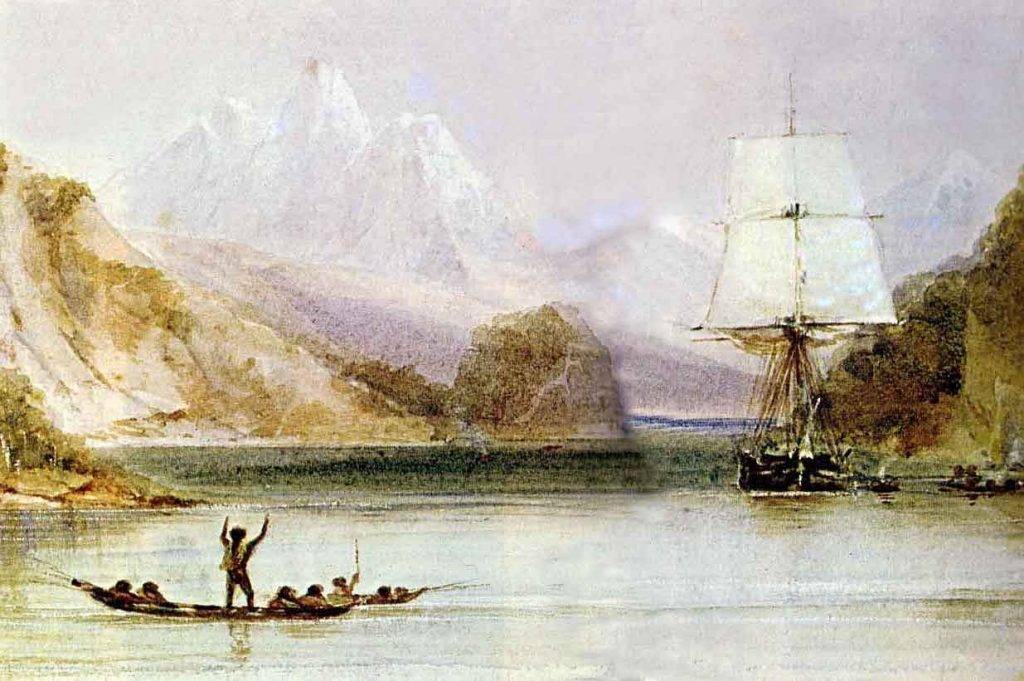
In 1846 Charles Darwin published the work “Geological Observation” in which he described his journey around South America. From this voyage, another accessory publication came to light, called “An account of the fine dust that often falls on ships in the Atlantic Ocean”. In this publication Darwin told of a very fine dust that covered the surface of the vessel (H.M.S. Beagle). This dust, which he hypothesized originated from Africa, was studied by him and his colleague Christian Gottfried Ehrenberg. Ehrenberg himself found within this dust 2 particular organisms of marine origin, among the 67 taxa identified. The two species identified were Grammatophora oceanica and Textilaria globulosa. Like any small thing to which Darwin paid attention and to which he devoted important studies, the first approach to aerobiology also derived from this apparently useless observation.
Aerobiology: definition
Ocean aerobiology is defined as the study of those biological particles of marine origin, including living organisms present in the atmosphere, their ecological, biochemical role and involvement in climatic processes. Obviously it is a definition adapted to the study of the relative marine aquatic environment. Generally, it is considered a new, multidisciplinary science, which studies the organic particles (bacteria, fungal spores, insects, pollen and viruses) present in the atmosphere, the sources of the latter, the modalities and effects on the environment. Particular attention is paid to marine microbial communities. It can be said that this has been used as a model to predict the diffusive behavior of viruses in diffuse airborne diseases, see SARS-CoV-2 virus. This is because of course we are talking about the diffusion of any biological material through the air vector.
Flows and microbial communities
The relevance of the air transport of marine microorganisms essentially depends on three factors:
- Flows of organisms between ocean and atmosphere;
- Distance covered by microorganisms in the atmosphere;
- Percentage of viable organisms after deposition through air movements.
To get a general idea of these phenomena, just think that trillions of microorganisms are usually exchanged daily between the ocean and the atmosphere. Factor on which the study of oceanic aerobiology is based. Hypothetically, through the movements of air in the troposphere, microorganisms can be dispersed over continents and oceans reaching a capillary distribution. Given the microbial richness of the oceans, it is important to characterize and quantify the marine aerobiota. By marine aerobiota, we mean precisely the set of living organisms that characterize the medium of air above the oceans, specifically marine microbial communities. Near the emerged lands, the aerobiota is mainly composed of terrestrial microorganisms, but moving away from these, the marine component prevails. Among these we find bacteria, viruses, Archaea and unicellular eukaryotes (or more complex eukaryotic cells).
Marine aerosols
However, the relevant studies regarding ocean aerobiology are unfortunately lacking. In particular, there is only one study on volatile microbial communities globally that does not include any reference to the oceans. In general we can distinguish between primary and secondary marine aerosols (Fig. 3). Primaries are directly emitted from the ocean surface into the atmosphere. They are generated by the breaking of the waves, which cause the trapping of air and organic material inside the bubbles. These bubbles, in contact with the surface, burst spreading the trapped material, generating what are called Sea Spray Aerosol (SSA).
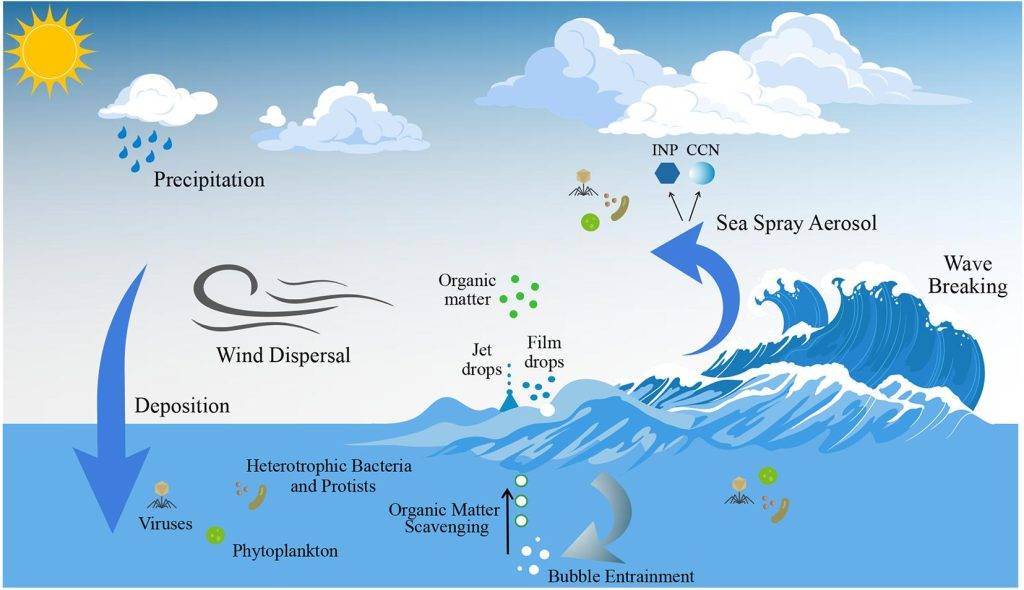
Secondary aerosols, on the other hand, are produced by oxidation of the volatile organic material emitted by phytoplankton species and bacteria. These require gaseous precursors for their formation. However, to deepen the discussion about marine aerosols, it is necessary to talk about sea surface microlayer or SML and volatile organic compounds (VOCs).
SML e VOCs
The characterization of the sea surface microlayer (SML) and volatile organic compounds (VOCs) are two key factors in the study of ocean aerobiology. With SML we indicate the most superficial micro-layer of the sea, between 1 and 1000 µm. It is possible to observe this layer when the wind does not have a speed higher than 10-13 m / s. It constitutes a unique environment, characterized by particular biological, chemical and physical properties. In this area the concentration of organic matter can be a thousand times higher than the underlying layers (in relation to the distension of the layer itself), including proteins, lipids, carbohydrates, protists, bacteria and viruses.
It has not yet been possible to accurately observe the microbial communities of this particular layer, although it is hypothesized that viral lysis plays a fundamental role in enrichment in organic material. Very often the microbial communities tend to aggregate in gelatinous matrices formed by particles of transparent exopolymers (TEP), recalling the formation of the phenomenon of marine snow. With VOCs instead we mean volatile organic compounds, among these we distinguish; acetaldehyde, acetone, acetonitrile, dimethyl sulfide (DMS), isoprene and other compounds.
Aerobiology: microorganisms
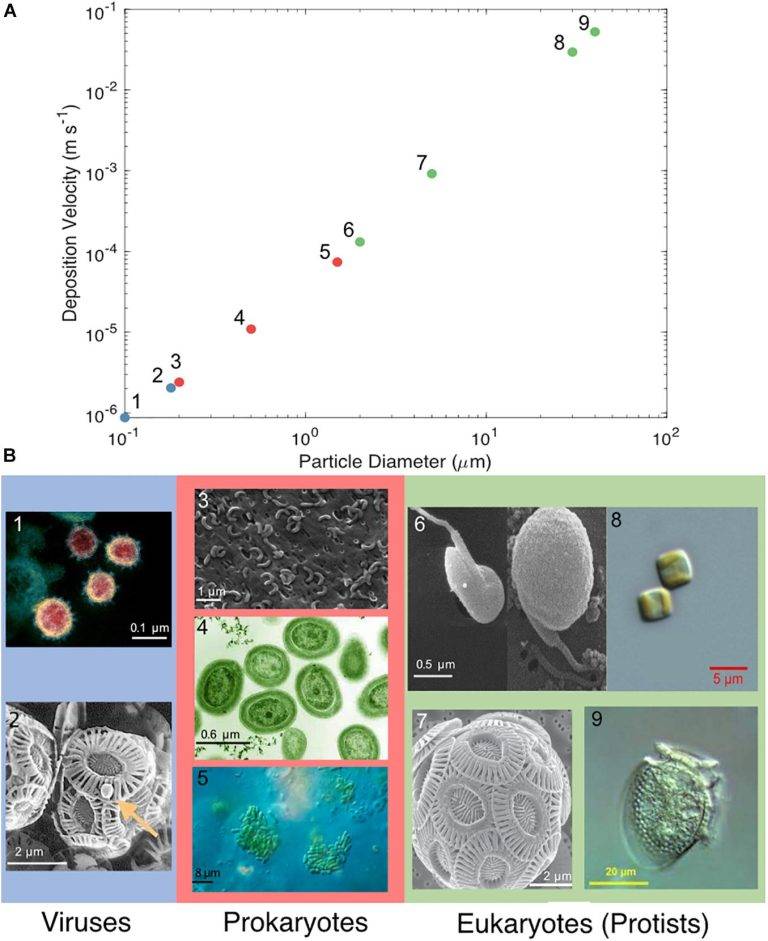
Wanting to describe marine microbial communities, it is possible to do so but in general, given the lack of specific studies that would allow their characterization. Volatile microorganisms can influence the distribution of specific ocean taxa, ecosystem structures and genetic exchange between different ecosystems. The key feature for this type of volatile exchange is the size of the microorganisms themselves. This is because the size can change the deposition rate (Fig. 4) of these, from the lowest values typical of viruses to the highest values of the largest eukaryotes.
This type of transfer can help overcome the obvious geographical barriers that we can normally find between the aquatic and terrestrial environments, which for obvious reasons prevent the movement of microbial clusters. According to research conducted by Jönsson and Watson (2016), a particle of water can travel for more than 9 years carried by water currents, while in the atmosphere it travels for a couple of days maximum.
Virus, Archaea and Bacteria
Thanks to ocean aerobiology we know that viruses represent the most widespread biological entities in the oceans, and thanks to phenomena such as viral shunt they play fundamental roles within global biogeochemical cycles. Thanks to their small size and high abundance, they represent a fundamental component of primary aerosols. They are concentrated in the SML layer, bound to exopolymers (TEP). In particular, it appears that lipid enveloped viruses are much more abundant due to their hydrophobic surface properties.
Regarding the Archaea, on the other hand, there is not much information in our possession, also due to the lack of microbial counting techniques capable of distinguishing between bacteria and Archaea themselves. For bacteria, on the other hand, it seems that sea air masses contain mainly gram-negative bacteria, an interesting difference compared to terrestrial air masses containing gram-positive. No clarification is yet available for this difference. However, we are able to say that bacteria with a mycolic acid coating tend to be more easily spread than others.
Eukaryotes and eukaryotic cells
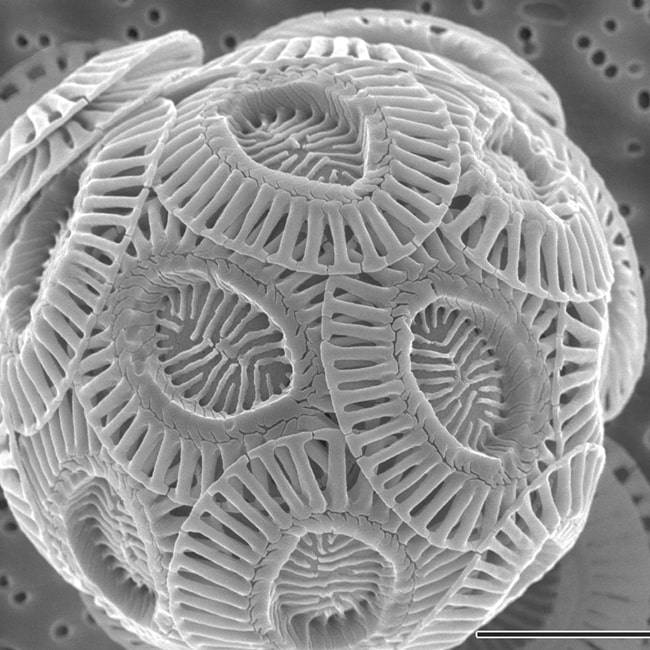
In relation to eukaryotes, on the other hand, we are talking about two distinct groups, protists and fungi. These two groups are the ones mostly found in the marine atmosphere. Examples of marine protists can be elements of phytoplankton (dinoflagellates, diatoms, coccolithophores) and heterotrophic organisms such as ciliates, foraminifera and radiolarians. Very often the transfer to the atmosphere occurs at the level of whole cells, in some cases even of fragments. One of the most studied organisms is Emiliania huxleyi, in particular pampered by its cell wall. Very often, in fact, the components of the cell walls are used as biomarkers to distinguish the different species.
Original article “L’aerobiologia oceanica (parte 1)” written by Luigi Gallucci
Translation by Giovanna Spinosa
Fonti
- Alsante, A.N., Thornton, D.C.O., Brooks, S.D., 2021. Ocean Aerobiology. Front. Microbiol. 12, 764178
- Darwin, C., 1846. An account of the Fine Dust which often falls on Vessels in the Atlantic Ocean. Quarterly Journal of the Geological Society 2, 26–30
- Jönsson, B.F., Watson, J.R., 2016. The timescales of global surface-ocean connectivity. Nat Commun 7, 11239
Images’ credits
- Figure 1: https://en.wikipedia.org/wiki/File:HMS_Beagle_by_Conrad_Martens.jpg
- Figure 2: https://commons.wikimedia.org/wiki/File:Oceano_Doce.jpg
- Image 3: https://www.frontiersin.org/articles/10.3389/fmicb.2021.764178/full
- Image 4: https://www.frontiersin.org/articles/10.3389/fmicb.2021.764178/full
- Figure 5: https://journals.plos.org/plosbiology/issue?id=10.1371/issue.pbio.v09.i06
- Image in evidence: wikimedia.org